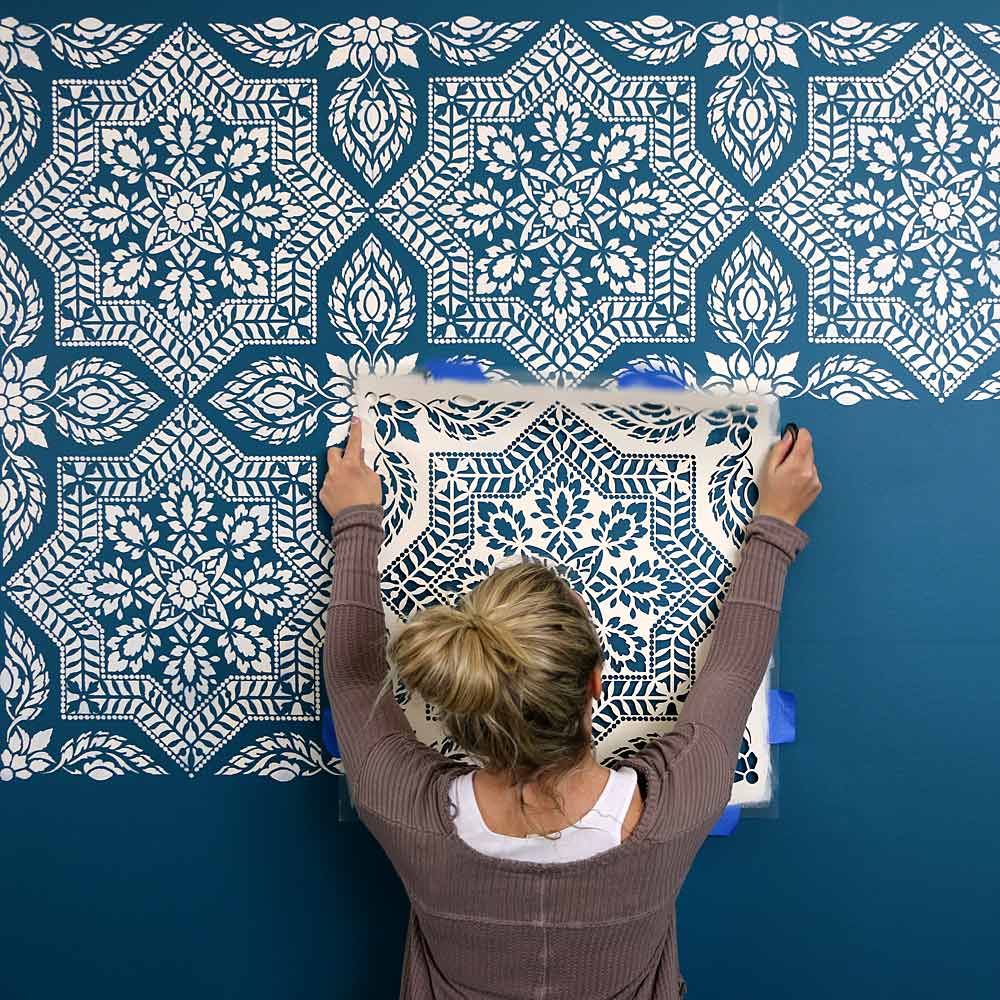
Lovely Moroccan stencil Zamira looks stunning on accent walls! Beautiful, intricate allover stencil pattern which has both traditional and contemporary flavors. Try it for your next DIY wall painting project! This intricate design will look stunning not just stenciled on your accent wall, but also on sisal rug, curtains or even stenciled on glass!
This stencil comes with an additional FREE Top part: the upper part of the design cut as a smaller separate stencil. It makes it easy to fill the gaps close to the ceiling line.
To see how to use Top part stencils, click here for Illustrated instructions:
Using Top Edge Stencils
This is a "filler" stencil, meaning you're filling in the pattern as opposed to outlining it. Keep this in mind when choosing your base coat color. Refer to Actual stencil picture (the last black and white picture) to see where the paint goes.
Stencil features an easy registration system, just use rows of the previously painted design to align the stencil, check for level and continue. This gives you a seamless "wallpaper" look. Don't worry about super perfect alignment: in the end your eye will never ever notice the discrepancy. We decorative pros "fudge" damasks and allover patterns all the time! The walls in most houses are often not straight, so some "fudging" while stenciling is very helpful and, in the end, not noticeable.
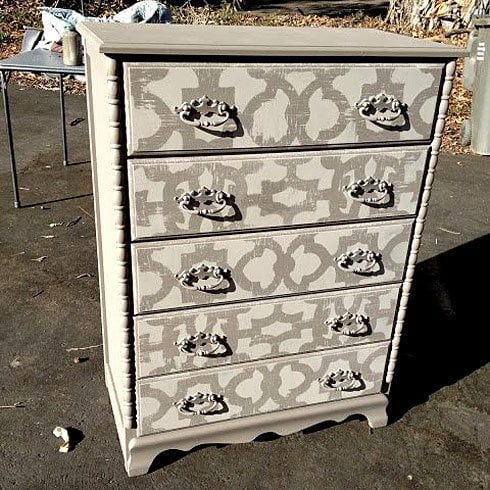
While prior stenciling experience is a plus for allover stencil patterns, even beginners get great results! This design is recommended for feature/accent wall or entire room. It also works for furniture and fabric embellishment.
Just look what Annie has created with this stencil pattern in her entryway (blue pic.) More on her blog, https://paiduptop.blogspot.com
And Lindsey from BetterAfter blog stenciled a stunning gray and white wall in her bath. Read about it on her blog, https://betterafter.blogspot.com
Try this stencil with our new Clip-On Stencil Level, (sold separately) and discover how easy it is to achieve perfectly level results without dealing with all those bulky heavy bubble levels and annoying laser levels.
Want to learn how to stencil a damask or allover pattern? Here are the detailed illustrated step-by-step Damask/Allover Stenciling Tips.
And make sure you watch our short step-by-step Video Tutorials!
You'll find them extremely helpful for your stenciling project. Even beginners get great results!
Although most of our stencils do not require the use of spray adhesive, if your walls have a texture to them, this pattern could benefit from it to help minimize paint seepage (Elmer's spray adhesive seems to be the best). Make sure you shake the can well and lightly mist (not drench) the stencil, and let it dry for a moment before positioning it on the wall. This step will prevent the adhesive residue transferring to the wall. You'll need to re-mist the stencil after a few repeats. Note: you will still need to hold the stencil in place with a few pieces of blue painters tape! Adhesive by itself is not enough to hold the stencil on the wall. Clean-up tip: Spray the stencil with Simple Green to help to remove adhesive residue.
About seepage and imperfections: Even with a proper loaded roller and correct technique you might get some minor paint seepage here and there. In most cases it's not noticeable, especially from a couple of feet away and it can be easily touched up with a small brush. Don't forget that you're creating a "hand-painted wall finish". A few imperfections and some paint seepage here and there are natural and inevitable for this type of work. To avoid seepage, use spray adhesive and less paint on your roller and brush.
Did you know you can stencil your own fabric and use it for curtains, tablecloths, pillows, etc.? When stenciling on fabric, please use stencil adhesive to ensure good results. First, tape your ironed fabric to the surface so it doesn't move around while you stencil. You'll get better results with stencil brushes, but sometimes roller can work too, depending on your fabric. Add some textile medium ( sold in craft stores) to your acrylic paint. You can also get a specially formulated fabric paint, but, frankly, good craft acrylic paint with a dollop of textile medium mixed in works just as well, and costs way less! :) Let the stenciled image dry completely, 24 hours is best, then heat-set it by ironing the fabric for about 20-30 seconds on a LOW setting through the piece of cloth. Heat-setting will cure the paint and will prevent it from being washed off in the washing machine. Always experiment with a sample of your fabric first to ensure good results. We have stenciled on silk, cotton, linen and even sheer fabrics with great results. It's always better if your fabric doesn't have too much texture.
All of our stencils are made of thick, sturdy but flexible 12 mil clear plastic, reusable, easy to clean and stenciler-friendly! In our 20+ years of professional stenciling this material has proven to be far superior than any other material we used, including the industry standard 8 mil mylar.
We are certain you'll notice the difference and will love working with it, just like all the folks who already bought our stencils.
Our stencils are made to last and with proper care and storage will serve you for long time.